
Blog
Sculptra vs. Juvederm: Key Differences and What to Know

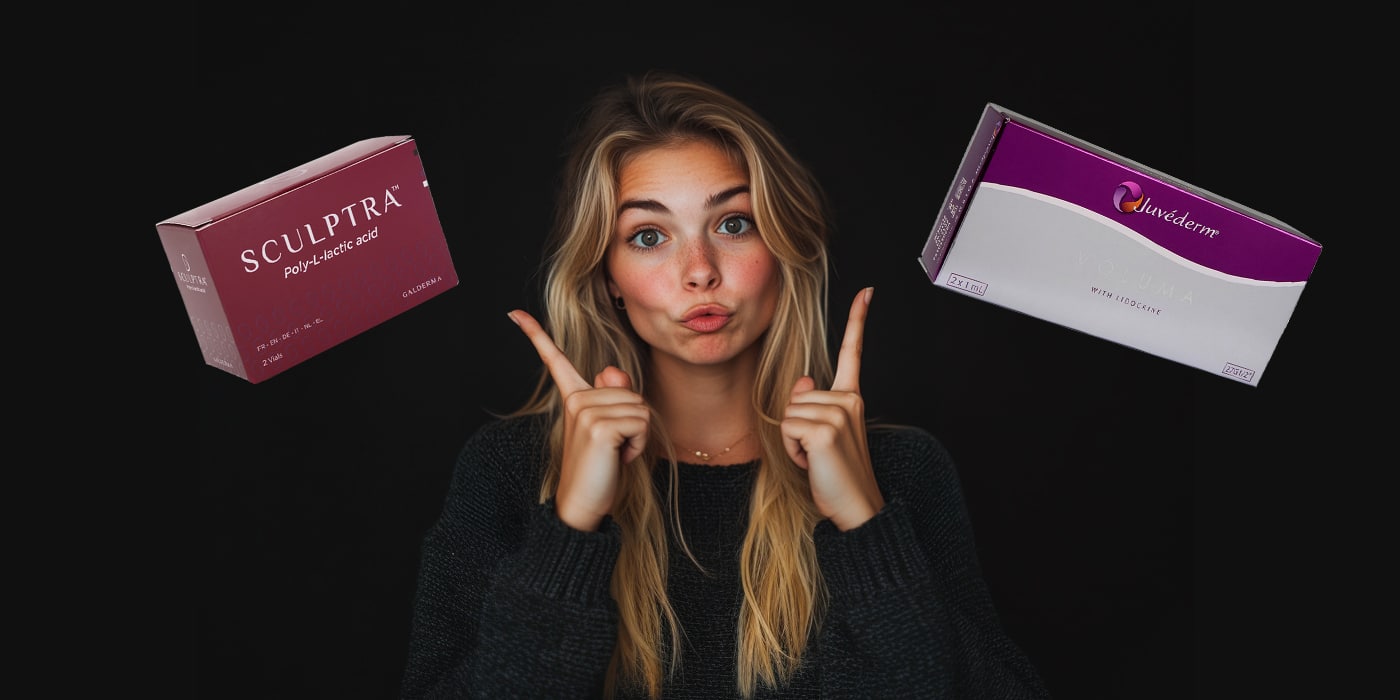
Sculptra and Juvederm are both injectables used for facial rejuvenation, but they solve different problems. Sculptra works by stimulating the body’s natural collagen production over time, while Juvederm is a hyaluronic acid filler designed for immediate correction. Treating them as interchangeable often leads to unrealistic expectations.
What Is Sculptra: Core Сoncept and Сlassification
Sculptra is a biostimulatory injectable treatment based on l lactic acid PLLA, a synthetic material known for its biocompatibility. Unlike classic dermal fillers that physically add volume under the skin, Sculptra works indirectly by encouraging the body’s natural collagen production over time. For that reason, it is generally classified as a collagen stimulator rather than a traditional filler, even though it is delivered through injection.
Sculptra treatment is chosen for diffuse volume loss and global aging rather than isolated wrinkles. The treatment philosophy focuses on gradual structural improvement and long‑term tissue support.
How It Works Biologically
After injection, the l lactic acid PLLA microparticles trigger a controlled inflammatory response that stimulates fibroblasts to increase the body’s natural collagen production. The initial fullness visible right after treatment largely comes from the sterile water used to dilute the product and usually subsides within a few days.
The biological sequence is gradual:
- The carrier fluid disperses and temporary volume fades.
- Fibroblasts begin producing new collagen fibers around the particles.
- Tissue density and support improve over the following weeks and months.
This slow remodeling process creates progressive volume restoration and improved skin quality. Because collagen stimulation is cumulative, multiple sessions are usually required.
Main Treatment Areas and Use Cases
Sculptra is most often used to address generalized volume depletion, sagging skin, and diffuse structural changes rather than small, sharply defined lines. Practitioners commonly treat the midface, temples, lower cheeks, and jawline when the goal is to rebuild facial structure in a subtle way. It can also help soften hollowing that develops with age and support overall skin firmness.
The treatment is best understood through outcomes: improving tissue support, restoring facial balance, and creating diffuse rejuvenation that develops naturally over time. In some cases, it is also used beyond the face where collagen stimulation can improve texture or volume gradually.
Typical Treatment Protocol
- Sculptra injections require two to three sessions spaced several weeks apart for full results.
- The product is diluted and injected deeply to distribute it evenly, and providers adjust the plan based on tissue response.
- Patients are commonly advised to massage treated areas regularly for several days to support uniform collagen stimulation. Because visible change develops gradually, results are assessed over time.
Expected Longevity and Maintenance
Patients often choose Sculptra for its long‑lasting and natural looking improvement. Because the treatment relies on new collagen formation, results can persist longer than many traditional fillers: the effects of Sculptra fillers typically last up to two years.
Maintenance is typically less frequent once the foundational volume has been restored. Instead of frequent touch‑ups, many patients return periodically for reinforcement sessions designed to sustain collagen production and counter ongoing aging changes.
What Is Juvederm: Core Concept and Classification
Juvederm is a family of hyaluronic acid (HA) dermal fillers designed to provide immediate volume restoration and contour refinement. Unlike biostimulatory products, Juvederm works by physically occupying space under the skin, so results are visible right after injection. Different formulations vary in density and elasticity to match specific treatment areas.
Juvederm filler functions as a toolkit for targeted correction: from subtle hydration and lip enhancement to stronger structural contouring in areas such as the cheeks or jawline. Its defining feature is precision: the injector selects texture and firmness based on the desired goals.
How it Works Biologically
Hyaluronic acid is a naturally occurring substance that attracts and binds water molecules, which explains the immediate volumizing effect seen after treatment. Once injected, the cross‑linked gel integrates into the surrounding tissue and adds support while maintaining flexibility.
Two biological traits make Juvederm injection distinct from stimulators:
- It produces instant mechanical volume rather than gradual tissue remodeling.
- It can be dissolved using hyaluronidase if adjustment or reversal is needed.
Because the gel slowly breaks down through natural metabolic processes, results fade progressively rather than disappearing suddenly. The rate depends on the product used, injection depth, and individual metabolism.
Main Juvederm Treatment Areas
Juvederm injection is commonly selected for areas where precision and instant correction are important, including lip augmentation, smile lines, marionette lines, under eye hollows, and deep creases. Other common indications include nasolabial folds, cheek contouring and chin projection with exact use depending on the specific formulation chosen by the injector.
Typical aesthetic goals include:
- Enhancing facial contours without surgery.
- Restoring localized volume loss and helping restore facial volume in targeted zones.
- Smoothing wrinkles and improving symmetry or proportion in specific zones.
- Achieving a refreshed appearance while keeping expressions natural.
Typical Treatment Sessions
A Juvederm appointment is usually completed in a single session, with optional touch‑ups depending on the desired outcome and level of correction. A topical numbing cream is often applied before injection to improve comfort during the treatment process. The injector maps the treatment area, selects an appropriate formulation, and places the filler with precision to achieve immediate shaping.
Patients often see immediate results once swelling settles, which makes this approach appealing for people seeking predictable, fast outcomes and immediate correction. Mild swelling or bruising may occur, but downtime is usually short.
Expected Llongevity and Maintenance
Juvéderm fillers provide immediate results that typically last between 6 and 18 months. Softer gels used in high‑movement zones such as the lips may fade sooner, while denser products placed deeper in structural areas often last longer. Because the Juvederm filler gradually dissolves, maintenance usually involves periodic top‑ups rather than full retreatment from scratch.
For many patients, the key advantage lies in predictability: results appear quickly, can be adjusted at follow‑up visits, and decline gradually over time. Common maintenance patterns include annual or semi‑annual touch‑ups, especially in areas with frequent movement or high metabolic activity, and pricing is often discussed per syringe depending on product density.
Mechanism of Action: Collagen Stimulation vs. Immediate Results
The key difference between Sculptra and Juvederm lies in what creates the visible result. Sculptra works indirectly by stimulating new collagen, so improvement develops gradually as tissue structure changes over time. Juvederm produces immediate results because the hyaluronic acid gel adds physical volume the moment it is placed under the skin.
| Aspect | Sculptra | Juvederm |
|---|---|---|
| Active substance | Poly-L-lactic acid | Hyaluronic acid |
| Result onset | Gradual | Immediate |
| Primary effect | Collagen stimulation | Instant volume |
| Reversible | No | Yes |
| Typical sessions | Multiple | Usually one |
| Longevity | Long-term, progressive | Medium-term |
Results and Aesthetic Outcomes
Although both treatments aim to improve facial balance, the final look differs mainly in speed and style of change:
- Sculptra tends to create subtle, progressive changes that appear as natural looking rejuvenation rather than visible filling. Because collagen develops gradually, improvements blend into existing facial structure and can also enhance skin texture over time.
- Juvederm delivers clearer definition immediately after treatment, which makes it popular for areas where cheek volume, lip filler refinement, and facial contours require precision.
Predictability and Adjustability
- Juvederm is generally considered highly predictable because the injector can see the effect during the session and make adjustments in real time. The additional advantage of reversibility provides flexibility if refinement is needed later.
- Sculptra requires a different mindset. Outcomes depend on individual collagen response, which means changes appear progressively and require follow‑up assessment rather than instant correction. Some patients appreciate this gradual process, while others prefer the instant clarity of HA dermal fillers.
Treatment Experience and Recovery
Both treatments are minimally invasive and performed in an outpatient setting, offering minimal downtime for most patients:
- Juvederm sessions tend to be shorter because correction is completed in one visit and the injector can evaluate results instantly, especially when treating lines and wrinkles such as forehead lines. Local anesthetic or lidocaine within the product helps reduce discomfort during placement.
- Sculptra sessions may involve wider treatment zones and deeper placement. The goal is broad distribution rather than sculpting one specific point, so treatment time varies depending on how much structural correction is planned.
Downtime Comparison
Patients can typically resume daily activities immediately after receiving Sculptra or Juvéderm injections, but post‑treatment effects differ:
- Juvederm may cause temporary swelling or bruising in treated areas, and the face can look slightly fuller during the first few days.
- With Sculptra, initial volume usually decreases quickly as the dilution fluid absorbs before collagen production begins. Visible downtime is typically limited, though mild tenderness may appear briefly.
Aftercare Requirements
Aftercare highlights one of the clearest practical differences between the two treatments:
- After Sculptra injections, patients should massage the treatment area five times a day for five minutes for five consecutive days.
- Juvederm aftercare is simpler and typically focuses on avoiding excessive pressure, heat exposure, or intense exercise for a short period. Because the gel stays where it is placed, no structured massage routine is usually necessary.
Safety Profile and Risk Considerations
Both Sculptra and Juvederm share common injection‑related effects such as swelling, redness, tenderness, and bruising. These reactions are usually mild and temporary, resolving within days depending on individual sensitivity and treatment area. But there are some product-specific risks:
- Sculptra carries specific risks related to technique and product distribution, particularly in patients with complex skin concerns. If not placed correctly or if aftercare is inadequate, small nodules or uneven texture may develop, which is why experience with dilution and injection depth is critical.
- Juvederm, as a hyaluronic acid filler, has risks linked to overcorrection or unintended placement, including rare complications involving a blood vessel that require immediate professional management. Precise anatomical knowledge is essential to minimize these possibilities.
Patients are advised to avoid blood thinners in the two weeks leading up to the procedure to reduce the risk of bruising and swelling.
Cost and Value Over Time
The cost of Sculptra and Juvéderm per syringe varies based on the geographical area and the quantity of vials used. Sculptra often requires multiple sessions upfront, which may increase early cost but reduce maintenance frequency later.
Juvederm usually involves a lower initial time commitment, yet periodic touch‑ups may be needed to maintain the same level of correction. The overall price of Sculptra and Juvéderm treatments depends on the filler brand, number of sessions, treatment area, amount of product used, and the clinic’s location and expertise.
Who Is a Better Candidate for Sculptra?
- Sculptra is typically suited for patients experiencing generalized facial volume loss who prefer gradual improvement rather than dramatic immediate change and want to restore facial volume over time.
- It works well for people who want long‑term collagen stimulation and are comfortable with a staged approach to treatment.
- Patients who value subtle evolution and broader structural support may find Sculptra aligns with their goals.
- It may be less ideal for someone seeking rapid correction before a specific event or highly localized enhancement.
Who Is a Better Candidate for Juvederm?
- Juvederm is often ideal for individuals seeking instant visible improvement in specific areas such as lips, folds, under eye hollows, marionette lines, or facial contours where smoothing wrinkles and restore volume goals are prioritized.
- The ability to see and refine results immediately makes it especially appealing for first‑time filler users who want predictability.
- Because hyaluronic acid fillers are reversible, patients who prefer flexibility may feel more comfortable starting with Juvederm.
- It is also a practical choice when precise shaping rather than global rejuvenation is the main goal.
Can Sculptra and Juvederm Be Combined?
Many practitioners combine both treatments within a long‑term aesthetic plan. Sculptra can provide foundational collagen support and overall volume restoration, while Juvederm is used later for precise shaping or refinement in specific areas.
This layered strategy allows patients to benefit from gradual tissue improvement while still achieving immediate contour adjustments where needed. Some clinics may also combine injectables with chemical peels to support overall facial rejuvenation and maintain a youthful appearance.
Decision Framework: How to Choose
Choosing between Sculptra vs. Juvederm starts with treatment goals rather than fillers brand comparison. Patients should consider whether they want instant correction or progressive improvement, targeted contouring or full‑face support, and whether reversibility matters to them.
A useful way to approach the choice is to reflect on lifestyle and expectations: how quickly results are needed, how often maintenance is acceptable, and how subtle or noticeable the changes should be after a dermal filler treatment. A consultation with an experienced injector remains the most reliable way to match treatment type with facial structure and long‑term goals.